
How Managed Uniform Programs Work
Jul
Managed uniform programs are a set-up where a business locks in approved uniform items, pricing, and ordering rules once, then lets employees or managers reorder without renegotiating every time. No more chasing down invoices for a single pair of pants. No more guessing what last year’s order looked like.
Who actually needs this? Any business past the “just buy uniforms when someone asks” stage. Construction crews, healthcare teams, grocery staff, transportation fleets, once you’re outfitting more than a handful of people, doing it one order at a time stops making sense.
What Is a Managed Uniform Program?
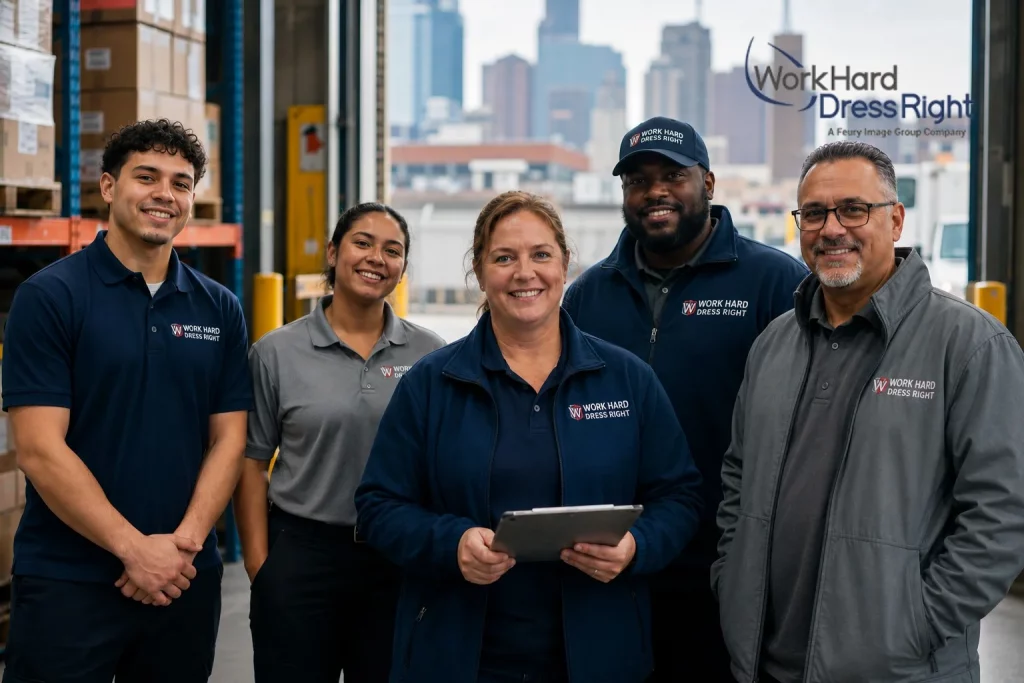
Managed Uniform Programs is a system, not a single purchase. A business sets an approved catalog, specific shirts, pants, jackets, whatever the job requires, and locks in pricing with a supplier. From there, new hires get outfitted fast, replacements happen without a purchase order fight, and everyone across every shift looks the same.
Compare that to the alternative. Without a program, someone in HR or ops is placing one-off orders, hunting for sizes, and re-explaining the same logo requirements every single time. That’s not a system. That’s just repeated errands.
Managed uniform programs fix this by putting the rules in place once. The ordering happens on autopilot after that.
If you want the full breakdown of how these programs work end to end, we’ve covered that in detail here.
Managed Uniform Apparel Programs: What Are They?
Uniform Store vs. Managed Program
People search for “uniform store” expecting a shop. And that’s part of it, but only part.
A uniform store is where the actual browsing and buying happen. It’s the storefront. A managed program is the system sitting behind that storefront: the approved item list, the pricing agreement, the budget rules, the reorder process. Without the program, a uniform store is just a regular retail experience: pick what you want, pay full price, repeat next time with no consistency.
With a managed uniform program layered on top, that same store becomes something different. Employees see only approved items. Pricing is already locked in. Managers don’t have to sign off on every single order because the rules were set up front.
So the store is the “where.” The program is the “how.” You need both, but the program is what actually saves time and money.
Managed Programs in Newark: How Local Businesses Set These Up
Newark businesses running managed programs in Newark tend to follow a similar path. Start with one department, say, warehouse staff or scrub-wearing healthcare workers, lock in the approved catalog for that group, then expand once the process is proven.
Here’s something you notice fast once you’ve set up a few of these: the businesses that struggle aren’t the ones with complicated uniform needs; they’re the ones who never wrote down what “approved” actually means. One manager approves a jacket, another approves a different jacket, and six months later, nobody’s uniform matches.
A working local program usually includes:
- One approved item list per department or role
- A single point of contact for sizing and reorders
- A locked logo file so branding stays consistent
- A clear budget per employee, reviewed annually
That’s it. Complicated isn’t the goal here. Consistent is.
Web-Based Uniform Stores and Direct Purchase Programs
Web-Based Uniform Stores
This is where a lot of the time savings actually shows up. A web-based uniform store lets each employee log in, see only what’s approved for their role, and order directly, with no manager relaying sizes back and forth by email.
There’s a knock-on effect too, one most businesses don’t plan for until they’ve lived with a manual system for a while. When every order routes through one person, that person becomes a bottleneck; vacations, sick days, and busy weeks all slow down uniform ordering for everyone else. A web-based store removes that single point of failure. Orders keep moving whether or not any one manager is at their desk that day.
Direct Purchase Programs
Pair a web-based store with direct purchase programs, and employees can buy their own gear within a set allowance, instead of every item routing through a central office. That’s a real shift for HR teams buried in uniform requests. It’s also a stronger setup than a traditional rental contract, since the business owns the garments outright instead of paying recurring fees on gear it never keeps.
Direct purchase uniforms work the same way but focus specifically on individual ordering rights; an employee gets access to buy what they need, when they need it, within the rules the business already set.
Why It Matters Day to Day
Why does this matter day to day? Because a new hire who needs three shirts and a jacket shouldn’t wait two weeks for someone to place that order manually. They log in, pick their sizes from the approved list, and are done.
Employee Uniform Allotments
Budgets are where a lot of programs fall apart if they’re not set up right. Employee uniform allotments solve this by giving each person a fixed dollar amount to spend within the approved catalog, instead of unlimited ordering, or the opposite problem, nothing at all until someone approves a request.
A typical allotment might cover a set number of shirts, a jacket, and a pair of pants per year, with replacements handled separately for wear and tear. The business sets the number once. After that, employees manage their own choices within that limit.
This is the part that actually reduces admin work. No more approving each purchase line by line. The allotment does that job automatically.
Uniform Procurement
Uniform procurement is the buying side of all this: how a business actually sources and pays for uniform items at scale, rather than one purchase at a time.
Done right, procurement through managed uniform programs means bulk pricing locked in up front, one vendor relationship instead of five, and predictable costs instead of surprise invoices. One thing that trips up a lot of growing businesses: they don’t realize how much money leaks out through inconsistent small purchases until they actually total up a year of one-off orders. It’s rarely one big expense. It’s fifty small ones that add up.
Structured procurement through a uniform management program closes that gap by locking pricing in advance and consolidating orders under one agreement.
There’s also a forecasting piece that gets overlooked. Once ordering runs through one program instead of scattered requests, a business can actually see patterns: which items wear out fastest, which sizes run short, which seasons spike demand. That’s data you simply don’t get when uniforms are purchased one-off, order by order, with no system tying it together.
Conclusion
A managed uniform program isn’t complicated once it’s set up; it’s just rules, written down once, so nobody’s re-deciding the same thing every month. If your team is still ordering uniforms one request at a time, that’s the sign it’s time for a program. Contact Work Hard Dress Right to set one up for your Newark or New Haven team.
FAQs
-
What is a managed uniform program?
It’s a system where a business locks in approved uniform items and pricing once, so employees or managers can reorder without renegotiating each time.
-
How much do employee uniform allotments typically cover?
Most allotments cover a set number of shirts, one jacket, and pants per year, with replacements handled separately.
-
Can employees order uniforms themselves?
Yes, through direct purchase programs and web-based uniform stores, employees can order within their allotment without manager sign-off on every item.
-
What’s the difference between a uniform store and a managed program?
A uniform store is where employees shop. A managed program is the system behind it, the approved catalog, pricing, and budget rules.
-
Do managed uniform programs save money over time?
Yes, mainly through bulk pricing and consolidated procurement, which cuts down the cost of small, inconsistent one-off orders.