
FR & Hi-Vis Utility Workwear Uniforms in Maplewood, NJ
Nov
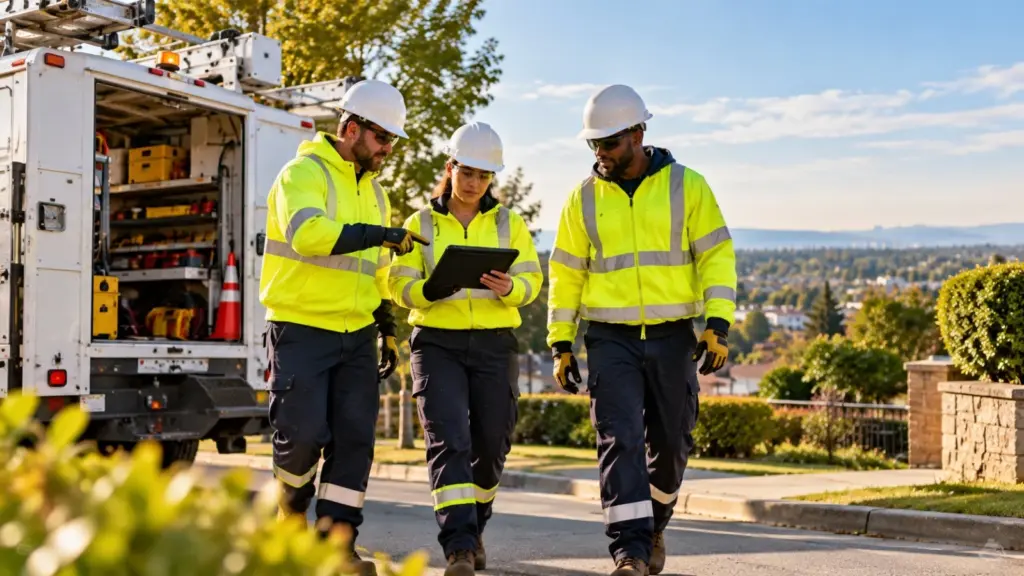
Maplewood isn’t an industrial town. There’s no refinery here, no big plant. But crews work in its streets all year, and they deal with real hazards when they do. A gas crew opening up a road needs drivers to see them. An electrical crew working near energized equipment may need protection from arc flash. Sometimes it’s the same crew on the same afternoon.
That’s why FR & hi-vis utility workwear is rarely a simple shirt order. Below, we’ll cover how to read the labels, match gear to the job, plan for New Jersey weather, and dodge the ordering mistakes that cause problems later.
One Garment, Two Jobs: Why Utility Crews Often Need FR and Hi-Vis Together
FR clothing and hi-vis clothing solve different problems.
- FR (flame-resistant) clothing is made to resist catching fire and to limit how far burning spreads across the garment.
- Hi-vis clothing is made to be seen. Bright background fabric and reflective trim help drivers and equipment operators spot a worker in daylight, at dusk, and after dark.
A crew working near traffic and near flame or arc hazards needs both. You can get there by layering separate pieces or by buying garments that combine the two. WHDR carries FR hi-vis clothing in shirts, vests, and jackets, along with the rest of its FR line.
Not every crew needs both. A sidewalk crew with no flame or arc exposure may only need hi-vis. A plant operator may only need FR. The job decides, not the catalog.
Here’s how it usually breaks down:
- Roadside and trench crews: visibility comes first. Whether FR is needed depends on the hazards at that site.
- Electrical crews: arc-rated clothing where arc flash is possible, plus hi-vis when working near traffic.
- Gas crews: flash-fire protection often comes up in the safety conversation, so ask your safety lead early.
- Parks and grounds crews: usually hi-vis and weather gear. FR is less common unless the work calls for it.
The Three-Label Check Before You Order FR Hi-Vis Workwear
Most ordering mistakes happen because someone skipped the tag. Before you buy, read the garment label and the spec sheet for three things.
- The FR claim. Does the garment say it’s flame-resistant? It’s also fair to ask whether the FR comes from the fibers themselves or from a finish applied to the fabric, since that can affect how the garment holds up over time and washing.
- The arc rating. If arc flash is possible on the job, look for an arc rating, usually shown as ATPV or EBT. All arc-rated clothing is flame-resistant. Not all FR clothing is arc-rated.
- The hi-vis class. ANSI/ISEA 107 sorts hi-vis apparel into Class 1, 2, and 3 based on how much bright background and reflective material the garment has. Class 3 gives the most visibility. Which class fits depends on traffic speed and how busy the work area is.
One more check: ask whether the reflective trim is flame-resistant too, not just the base fabric. A garment is only as protective as its weakest part.
None of this replaces a hazard assessment. Your safety lead or a qualified safety professional decides which ratings your crew needs. We can help you shop to that rating. We can’t set it for you.
Matching the Garment to the Hazard
Use this as a starting point when you’re sorting out what to order. Ratings vary from one garment to the next, so confirm them on the specific item.
| Garment | Typical use | What to check | Watch out for |
|---|---|---|---|
| FR hi-vis shirt | Everyday crew wear near traffic | FR label, hi-vis class, arc rating if needed | Hi-vis class that doesn’t match the work zone |
| FR hi-vis vest | Quick visibility layer over FR clothing | Vest fabric itself is FR, hi-vis class, fit over layers | A standard vest worn over FR gear |
| FR hi-vis jacket or coat | Cold, wet or windy work | FR rating, hi-vis class, insulation and lining | Non-FR linings or add-ons |
| FR coveralls or bibs | Full-coverage tasks | FR rating, mobility, how it pairs with a hi-vis layer | Heat build-up in summer |
| FR rain gear | Wet-weather jobs | FR rating and visibility needs for the site | Gear that sheds water but isn’t FR |
| FR pants | Lower-body protection | Same FR rating and fabric family as the shirt | Mismatched ratings top to bottom |
WHDR lists Workrite FR and Bulwark among the brands for utility workwear, and you can browse the full range on its utility industry page.
What Utility and Roadside Work Looks Like in Maplewood
Maplewood doesn’t run on one industry. Small shops and services keep the Village and Springfield Avenue busy, and the township’s parks, including Memorial Park and South Mountain Reservation, need crews year-round. Utility and roadside work here tends to show up as projects: a street gets opened up, a line gets repaired, a storm brings something down.
A few of those jobs shape what crews should wear.
- Work in the road. Gas line replacement in Maplewood has meant trenching in road surfaces and working block by block, and a project like that can run for months. Crews spend that time close to moving cars, parked cars, and foot traffic.
- Tight, busy streets. Around the Village and along Springfield Avenue, there’s little room to spare. Crews work beside storefronts, pedestrians, and delivery trucks, often in the same stretch as traffic.
- Storm response. After Hurricane Sandy in 2012, most of Maplewood lost power and restoration stretched over days. Those jobs mean long hours, bad weather, and low light.
- Parks and grounds. Crews at places like Memorial Park deal with weather and uneven ground more than anything else. Hi-vis and rain gear matter most there.
- Work near the rail line. NJ Transit service runs through Maplewood. Anyone working near tracks should check the railroad’s own rules, because they can differ from standard hi-vis requirements.
Four questions sort most of this out before you open a catalog:
- Will the crew work in or beside traffic lanes?
- Is there any chance of arc flash or flash fire at the site?
- Will the job run into dusk or nighttime?
- Will people be out in rain, heat, or cold for long stretches?
One crew might face several of these conditions in a single month. Choose FR & hi-vis utility workwear that suits the hazards your team may encounter, rather than focusing on just one type of job. For other uniform needs, explore workwear and uniforms in Maplewood, NJ.
Dressing for New Jersey Weather Without Losing Protection
Maplewood summers are hot and humid. Heavy FR fabric in July is miserable, and miserable crews cut corners. They unbutton shirts, roll sleeves, or shed layers, and that can leave gaps in protection.
Lighter FR options exist, including lightweight FR pants and shirts, so it’s worth asking about weight before you order a full crew’s gear.
Cold snaps and rain call for different pieces.
- Winter: FR jackets and FR sweatshirts are available, which keep warmth inside the FR system.
- Rain: FR rain gear exists for wet-weather work. Check whether the site also needs a hi-vis class on the outer layer.
- Layers underneath: what goes under an FR garment can affect how the whole outfit performs, and some synthetic fabrics can melt under heat. Ask your safety lead what’s approved before you tell crews to layer up.
A seasonal kit works better than one outfit for everything. Think a lightweight summer shirt, a base layer, a rain shell, and a winter jacket, all checked against the same hazards.
Five Ordering Mistakes That Waste Money and Leave Gaps
Choosing FR and hi-vis workwear involves more than picking the right color or fabric. The wrong garments, incompatible layers, or incorrect customization can leave crews without the protection they need and lead to unnecessary replacement costs. Before placing an order, watch out for these five common mistakes.
- Assuming hi-vis means flame-resistant. A bright vest can be an ordinary vest. Check the label for an FR claim.
- Assuming FR means arc-rated. If arc flash is possible, you need an arc rating on the tag, not just an FR claim.
- Mixing pieces without checking. A garment that’s FR on top and non-FR underneath, or the other way around, can undercut the protection you paid for.
- Adding logos or striping without asking. Placement and materials can affect how a garment meets its standard, so ask before decorating FR or hi-vis gear. WHDR does its embroidery, printing, and reflective striping in-house, which makes that a short conversation.
- Ordering for today only. Skipping a size run, forgetting new hires, and scrambling when someone tears a sleeve all lead to rush orders and mismatched gear.
Caring for FR Hi-Vis Gear and Knowing When to Replace It
FR clothing needs proper care. Improper washing, heavy contamination, or excessive wear can affect how well it performs. Follow the care label and the manufacturer’s guidance, and give crews those instructions in writing if they wash gear at home.
Hi-vis wears out in its own way. Colors fade, and reflective trim cracks or peels. When a garment looks dull, torn, or worn at the trim, it’s time to look at replacing it.
Put a simple repair-or-replace rule in writing, and have your safety lead sign off on it. That way nobody has to guess at the start of a shift.
How a Managed Program Takes Reordering Off Your Plate
Reordering is where most crews’ gear plans fall apart. Sizes change, people leave, people join, and someone has to remember which garment carries which rating.
WHDR’s uniform program options cover that. For teams that have outgrown one-off orders, the branded apparel programs include an ordering portal, managed allowances,s and shipping straight to your staff. If you only need a handful of pieces, direct purchase has no minimums, so you can order exactly what you need.
A managed uniform program helps keep workwear consistent as your team grows. New hires can get the right gear, replacements are easier to manage, and crews can reorder the same garments without starting from scratch. Learn more about WHDR’s managed program for high-visibility and FR workwear.
Why Choose Work Hard Dress Right
Work Hard Dress Right offers FR and hi-vis workwear for utility crews, along with in-house embroidery, screen printing, heat-seal, and reflective striping. With 25+ years in workwear, WHDR helps businesses manage uniforms, sizing, reorders, and branding.
The Newark store is located at 283 Ferry Street and is open seven days a week. Visit in person to explore workwear options or browse WHDR’s online store for your team’s needs.
Ready to Gear Up Your Crew? Start With a Quote
Tell WHDR about your crew’s workwear needs, site requirements, and timeline. From FR and hi-vis garments to custom branding and managed uniform programs, Work Hard Dress Right can help you find the right fit for your team. Looking for FR & hi-vis utility workwear in Maplewood, NJ? Request a quote or visit the Newark store.
Work Hard Dress Right
283 Ferry Street, Newark, NJ 07105
Phone: (973) 465-0900
Mon–Fri 10am–6pm | Sat–Sun 10am–5pm
FAQs
- Is FR clothing the same as arc-rated clothing?
No. All arc-rated clothing is flame-resistant, but not all FR clothing is arc-rated. If arc flash is possible on the job, look for an arc rating on the label, shown as ATPV or EBT.
- What hi-vis class do utility workers need?
ANSI/ISEA 107 has three classes, and Class 3 offers the most visibility. The right one depends on traffic speed and work conditions, so your safety lead or employer should make the call.
- Can one garment be both FR and hi-vis?
Yes. FR hi-vis garments combine flame-resistant fabric with hi-vis color and reflective trim. Check the label for both claims. WHDR carries FR hi-vis clothing including shirts, vests and jackets.
- Does hi-vis clothing protect against fire?
Not by itself. A hi-vis garment only offers flame resistance if it’s specifically described as FR. Check the tag.
- Can you add logos or striping to FR hi-vis gear?
WHDR does embroidery, screen printing, DTF, heat-seal, and reflective striping in-house. Placement can affect how a garment meets its standard, so talk to the team before you decorate anything.
- Do you work with small crews?
Yes. WHDR works with small teams all the time, and its direct purchase program has no minimum order.
- Can I order online?
Yes. You can order online and have it shipped to your business, or stop by the Newark store.
- How far is the Newark store from Maplewood?
It’s a short drive. The store is at 283 Ferry Street, Newark, NJ 07105, in the Ironbound section, and it’s open seven days a week.