
Durable Automotive Workwear Uniforms in Newark, NJ: What Auto Shops Need to Know
Sep
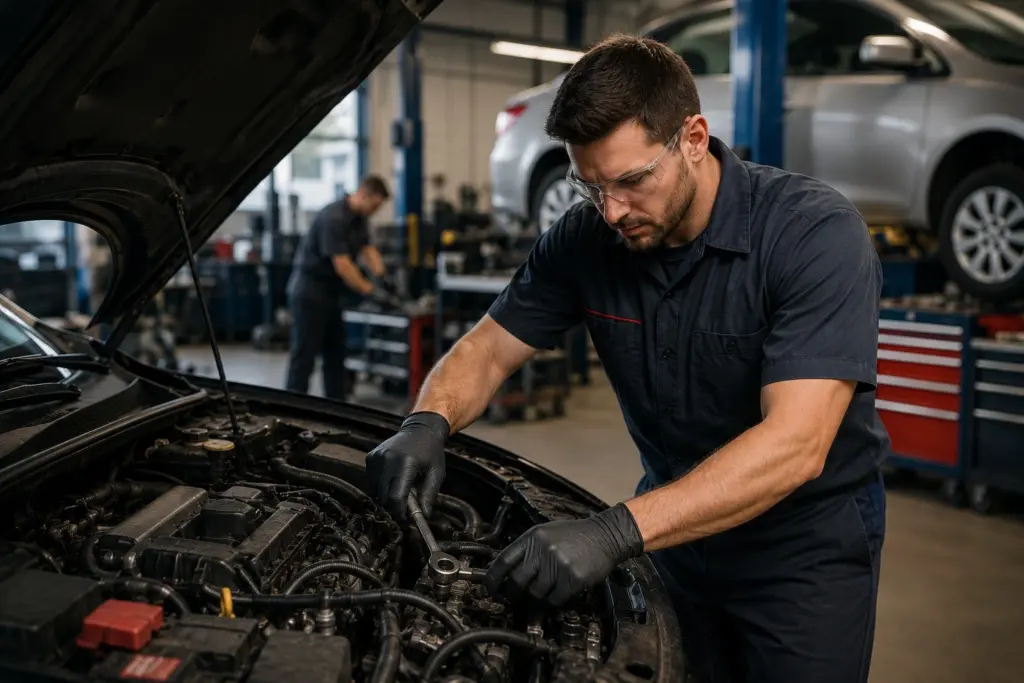
Grease doesn’t care about your uniform budget. Automotive workwear uniforms have to survive oil, engine heat, constant kneeling, and a shop floor that doesn’t slow down for anybody. Auto shops, dealerships, parts businesses, and service teams across the city deal with the same problem every season: uniforms that look fine in the catalog and fall apart in the bay.
This isn’t a product list. It’s a real look at what actually holds up, what different roles in an automotive business actually need, and where most shops get it wrong before they even place their first order. Work Hard Dress Right built this from what actually comes back as a reorder, not from a spec sheet.
What Makes Automotive Workwear Uniforms Different From General Work Uniforms
A construction jacket and a mechanic’s shirt might look similar on a rack. They’re not solving the same problem. Automotive workwear uniforms in Newark, NJ, have to be built around the specific demands of the shop, from oil and grease exposure to constant kneeling, reaching, and movement.
Automotive environments throw a specific set of demands at a uniform:
- Oil, grease, dirt, and shop fluids that stain and degrade regular fabric fast
- Repeated movement, kneeling under a car, reaching into an engine bay, twisting into tight spaces
- Abrasion from metal edges, tools, and rough surfaces
- Heat swings between a hot engine compartment and a cold bay in winter
- A professional look for anyone facing customers, not just the techs in back
- Visibility and safety needs where the job actually calls for it
None of this is automotive-specific hype. It’s just what the job actually involves, day after day.
Role-by-Role: Technicians, Front Counter, Parts & Delivery
Not every job in an auto shop needs the same shirt:
- Technicians and mechanics need durability first. Oil-resistant fabric, reinforced knees for kneeling, and enough mobility to twist and reach without a seam giving out.
- Service advisors and front-counter staff face customers all day. Their uniform needs to look sharp and stay wrinkle-resistant more than it needs oil resistance, though a splash-proof finish never hurts near the bay.
- Parts employees split the difference: enough durability for handling heavy or dirty parts, enough presentability for customer-facing counter work.
- Parts and delivery drivers need comfort for time behind the wheel and, depending on the role, visibility gear for loading docks or roadside stops.
- Shop and support crews doing cleanup, inventory, or general labor need practical, durable basics without the customer-facing polish the front counter needs.
Treating all five roles the same way usually means somebody’s uniform doesn’t actually fit the job they’re doing.
Fabric Technology That Actually Matters: Touchtex™, MIMIX™, OilBlok™
A lot of “durable” workwear claims don’t hold up past the first wash. WHDR’s automotive line uses named fabric technologies rather than a vague durability claim: Touchtex™, MIMIX™, and OilBlok™, described as breathable, durable, moisture-wicking, and rip- and stain-resistant.
Worth knowing: these same technologies show up on WHDR’s manufacturing workwear in Newark, too. That’s not automotive-only marketing; it’s part of a broader fabric platform WHDR applies across more than one industry, which suggests the technology is a real material choice, not a term invented for one product page.
What that means in practice: fabric that resists staining from grease rather than just hiding it, moisture-wicking properties for hot bays, and stretch or mobility built into stress points instead of a stiff cut that fights every kneel and reach.
Compliance: NFPA 2112/70E and ANSI Hi-Vis for High-Risk Bays
Not every automotive role needs flame-resistant or hi-vis gear. This matters, and it’s worth being precise about.
WHDR’s automotive line includes compliance-ready options, NFPA 2112/70E and ANSI-rated hi-vis choices built for high-risk automotive environments. That’s different from saying every garment on the shelf carries those certifications. The right call depends on the specific hazard a role actually faces.
A technician working near welding equipment or electrical systems has a different exposure profile than a parts counter employee. ANSI hi-vis matters for roles with real visibility concerns, a loading dock, an outdoor lot, or low-light conditions, not as a blanket requirement for anyone wearing a shop uniform.
The safest approach: match the specific garment’s stated rating to the specific hazard a role faces, rather than assuming “automotive” as a category automatically means everything is compliance-rated.
Automotive Shirts, Pants, and Coveralls: What to Look For
A few practical things to check before ordering:
- Durability at stress points: knees, elbows, seams that take repeated movement
- Oil and grease resistance, not just a stain-resistant label
- Breathability for hot shop conditions, especially in summer
- Visibility features where the role actually requires them
- Mobility and fit: a uniform that restricts reaching or kneeling gets worked around, not worn correctly
- Easy care: fabric that survives frequent washing without breaking down fast
- Seasonal layering options for shops that get cold in winter
- Matching the garment to the task: a coverall for heavy work, a shirt-and-pant combo for lighter roles
Skipping any of these usually shows up as a complaint within the first few weeks, not a surprise months later. A pair of pants that looks fine on a hanger can still be the wrong choice if nobody checks how it moves once someone’s actually kneeling under a lift.
How to Choose an Automotive Workwear Program
Individual garments work fine for a small team. A full program makes more sense once sizing, reorders, and consistency start becoming a real coordination problem.
A solid automotive workwear uniform program covers:
- Correct sizing and fit collected upfront, not guessed
- A clear process for onboarding new hires without delays
- A plan for replacement garments as gear wears out
- Consistent uniforms across multiple locations, if that applies
- Branding that stays uniform across every order
- A structure that scales as the business grows, instead of needing to be rebuilt later
The difference between ordering shirts once and running an actual program is mostly about what happens after the first order: reorders, new hires, and keeping everyone looking consistent six months later. A single order solves today’s problem. A program solves it every time it comes back around.
Where Automotive Crosses Into Other Industries
Automotive workwear uniform needs don’t stay perfectly contained to auto shops.
Transportation businesses running fleets and diesel mechanics, or shop crews maintaining vehicles, face nearly identical demands: oil resistance, durability, mobility. WHDR’s transportation offerings specifically include gear for fleet mechanics and shop crews for exactly this reason.
Manufacturing shares real overlap too: shop-floor conditions, the same fabric technologies (Touchtex™, MIMIX™, OilBlok™), and similar durability priorities. A business running both a shop floor and an automotive service bay isn’t necessarily buying from two different uniform categories.
Proof It Works: The Parts Authority Rollout
WHDR outfitted a national auto parts chain, with more than 3,000 employees across 200-plus locations, with consistent, branded workwear spanning drivers, warehouse staff, and customer-facing employees. The rollout included branded polos, outerwear, and work shirts, built around a custom ordering portal that let location managers place, track, and reorder uniforms without the guesswork of managing it manually across that many sites.
That’s a real, documented example of an automotive-adjacent uniform program handling scale and consistency at once, not a hypothetical. It’s also a useful reference point for what a program actually needs to solve once a business grows past a handful of employees: tracking, reordering, and keeping every location looking the same without someone manually managing it location by location.
Comparison Table
|
Garment Type |
Best Use | Key Features |
When to Choose It |
|
Work Shirt |
Front counter, light-duty roles | Wrinkle-resistant, professional look |
Customer-facing roles, moderate mess exposure |
|
Work Pants |
General shop wear | Durable, reinforced stitching |
Most technician and support roles |
|
Coveralls |
Heavy technician work | Full coverage, oil/grease resistance |
High-mess tasks, frequent kneeling and reaching |
|
Hi-Vis Apparel |
Loading docks, outdoor/low-light areas | ANSI-rated visibility |
Roles with real visibility risk, not every technician |
|
FR Apparel |
High-hazard bays (welding, electrical) | NFPA 2112/70E compliance-ready options |
Roles with documented flame or arc exposure |
Custom Branding and Managed Uniform Programs
A uniform with a shop or dealership’s logo does more than look tidy; it’s part of how customers judge professionalism before a single word is said.
WHDR offers custom branding and colors added to automotive garments, along with managed uniform programs in Newark, NJ, designed to simplify ordering, control costs, and keep the workforce consistent. For multi-location businesses, consistency matters more, not less. A customer at one location should see the same professional look as one at another.
Replacement garments and new-hire onboarding are part of the same problem a managed program is built to solve, rather than something handled as an afterthought each time it comes up.
Common Mistakes Auto Shops Make
Choosing standard street clothes over purpose-built automotive workwear often leads to quick garment wear, safety compliance risks, and an unprofessional appearance. Investing in proper shop apparel protects both your technicians and your business.
- Choosing uniforms based on price alone, then replacing them within months
- Ignoring fit and mobility, leaving technicians fighting their own clothes to do the job
- Using the same garment for every role instead of matching gear to what the job actually demands
- Skipping oil and grease resistance and wondering why uniforms look ruined within weeks
- Forgetting seasonal needs, leaving a shop crew underdressed once winter hits
- Choosing hi-vis or FR gear without checking whether the role actually requires it, or skipping it for a role that does
- No plan for replacements or new hires, so the uniform program falls apart the moment staff changes
Fine Thoughts
Durable automotive workwear uniforms in Newark, NJ come down to matching the right garment to the right role, durability where the job demands it, professionalism where customers see it, and compliance where the hazard actually calls for it. Contact Work Hard Dress Right to build an automotive uniform program suited to how your shop actually runs.
FAQs
- What makes automotive workwear different from regular work uniforms?
Automotive workwear has to handle oil, grease, and repeated kneeling and reaching that general work uniforms aren’t built for, while still looking professional in customer-facing roles.
- Do all automotive employees need the same uniform?
No. Technicians, front-counter staff, parts employees, and delivery drivers all have different priorities, durability, presentability, or mobility, depending on the role.
- Does every automotive garment need to be flame-resistant or hi-vis rated?
No. Compliance-ready options exist for high-hazard roles, but the right choice depends on the specific hazard a role faces, not a blanket rule for the whole shop.
- What fabric technologies does WHDR use in automotive workwear uniforms?
Touchtex™, MIMIX™, and OilBlok™, described as breathable, durable, moisture-wicking, and stain-resistant technologies, are also used in WHDR’s manufacturing line.
- Is it better to order individual garments or set up a full uniform program?
Individual garments work for very small teams. A managed program makes more sense once sizing, reorders, and consistency across multiple employees or locations become an ongoing need.
- Can automotive uniforms be customized with a shop or dealership’s logo?
Yes. Custom branding and color options are available, which help keep a consistent, professional look across a team or across multiple locations.
- Has WHDR handled a large-scale automotive-adjacent uniform rollout before?
Yes, WHDR outfitted a national auto parts chain with more than 3,000 employees across over 200 locations, covering drivers, warehouse staff, and customer-facing roles with a custom ordering portal.
- What’s the most common mistake auto shops make when buying uniforms?
Choosing based on price alone or using one garment style for every role, both of which usually lead to replacing uniforms sooner than expected.