
Outdoor Workwear Coats and Jackets for Newark, NJ
Sep
A retail jacket from a mall store won’t survive a full winter on a Newark job site. Outdoor workwear coats and jackets are built differently: heavier fill, tougher shells, and stitching that holds up to daily abuse instead of a Saturday hike. If you’re outfitting a crew that works outside through a Newark winter, the difference between real work outerwear and a regular coat shows up fast, usually around the third or fourth cold week when the retail jacket starts losing its warmth.
Work Hard Dress Right has outfitted Newark crews through enough winters to know which coats actually hold up and which ones look good on a rack and fall apart on a job site. This guide breaks down outdoor workwear coats and jackets: insulated coats, waterproof options, safety-rated outerwear, and fleece jackets, what each one is actually for, and how to pick the right one instead of guessing. It’s written from what actually shows up at the counter every winter, not a generic list pulled from a manufacturer’s spec sheet.
Why Newark Weather Demands Real Outdoor Workwear, Not Retail Jackets
Newark winters swing hard. Cold wind off the water cuts through thin fabric fast, and a crew working outside for eight or ten hours needs a coat built for that exposure, not a jacket built for walking between a car and an office. Work Hard Dress Right sees this every season: customers who bought a cheaper coat somewhere else, back in the store by January, looking for something that actually holds up.
Retail outdoor workwear coats and jackets are built for looks and light use. Outdoor workwear coats and jackets are built for repeated wear, tougher conditions, and a lot more abuse than a normal winter coat ever sees. The fabric is heavier. The seams are reinforced. The fit accounts for movement, not just standing around. Buy the wrong one, and you’ll be back at the store, or online, reordering before February even starts.
Insulated and Heavy-Duty Outdoor Workwear Coats and Jackets
Not every insulated coat is built the same way when selecting outdoor workwear coats and jackets in Newark. Some are made for standing still in the cold, while others are made for working hard without overheating.
What “insulated” actually means.
Insulation isn’t one thing. Some coats use synthetic fill, which stays warm even if it gets a little damp. Others use heavier quilted layers built for extreme cold. The warmth rating on a coat should match the actual conditions a crew works in, not just “it’s winter, buy the warmest one.” A crew doing heavy physical labor outdoors often needs less bulk than a crew standing mostly still, since movement generates its own heat. And a coat that’s too warm for the actual activity level gets unzipped or left in the truck, which defeats the entire point of buying it.
Construction-grade coats durability priorities
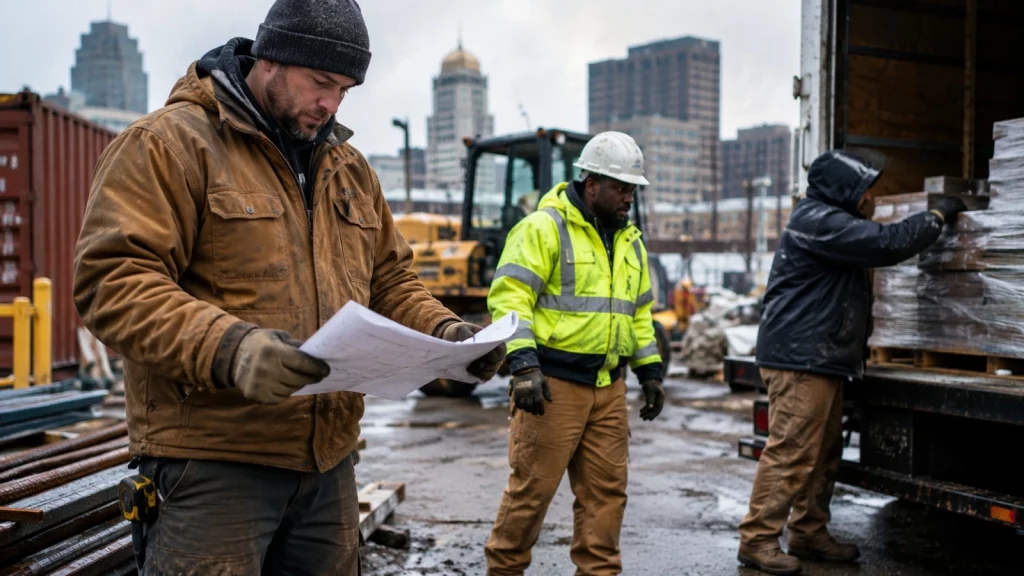
Construction work coats need reinforced shoulders and elbows, tough exterior fabric that resists tearing on rebar or rough material, and enough room to layer underneath without restricting movement. A coat that looks warm but rips on the first snag isn’t actually doing its job. Work Hard, Dress Right sees this play out constantly with crews who bought a coat based on price alone, only to be back within a month for something built to actually survive a job site.
Waterproof and Weatherproof Options
Waterproof and weatherproof aren’t the same thing, and this trips people up constantly. Weatherproof coats resist light rain and wind but aren’t built for sustained exposure. Waterproof coats use sealed seams and a genuine waterproof shell, built for crews working outside through real rain, not just a drizzle on the walk to a truck. If a crew is outside in wet conditions for hours at a time, weatherproof isn’t enough; waterproof is the right call, even though it usually costs more. So ask the actual question before buying: Is this crew occasionally caught in the rain, or genuinely working through it? The answer changes which coat is worth the money.
Safety Work Coats: Hi-Vis and FR Considerations
Some outdoor work calls for more than warmth. Crews working near traffic or heavy equipment need hi-vis rated outerwear, not just a coat that happens to be orange. ANSI-rated hi-vis outerwear meets a specific reflective and fluorescent material standard; a bright jacket without the rating doesn’t count for compliance purposes. Work Hard Dress Right stocks hi-vis outerwear that meets these ratings directly, not generic bright-colored jackets marketed as safety gear without the certification behind them.
FR-rated outerwear matters for crews working around fire or arc flash hazards. A regular insulated coat, even a good one, doesn’t belong as an outer layer over FR gear unless it’s specifically rated for that use, a detail that gets missed more often than it should. Work Hard Dress Right stocks FR-rated outerwear built specifically for this, so a crew doesn’t end up wearing an unrated jacket over gear that was supposed to be protecting them.
Fleece Jackets: The Layering Piece Most People Get Wrong
Fleece gets treated like a full winter coat more often than it should. It’s warm, comfortable, and cheap, right up until the wind hits. Here’s what fleece is actually good for, and where it falls short.
When fleece works alone vs. as a mid-layer
Best fleece jackets in Newark work great on their own in mild fall or spring weather, or as an indoor layer in a cold warehouse. In real winter conditions, fleece works best as a mid-layer under a shell, not as the only layer against Newark wind. Treating a fleece jacket as a full winter coat is one of the more common mistakes crews make heading into the season. It’s warm right up until the wind picks up, and then it isn’t doing much at all.
Men’s fleece jacket options and fit
A good work fleece fits close enough to layer under a coat without bunching, with enough stretch to move freely. Full-zip styles work better than pullovers for crews who need to adjust their layers throughout a shift as temperatures change, since a full zip lets someone vent heat without taking the whole layer off. A quarter-zip works fine for milder days but doesn’t offer the same flexibility when temperatures swing hard between morning and afternoon.
Brands We Carry for Outdoor Workwear Coats and Jackets
Work Hard Dress Right carries Carhartt, Dickies, and Red Cap for outdoor workwear, all in stock and ready to ship rather than special order. Carhartt remains the most requested brand for heavy-duty work coats, largely because it’s built specifically for job site abuse rather than general outdoor use. The North Face brings genuine technical outerwear expertise to the lineup, useful for crews who need serious weatherproofing without sacrificing mobility. Champion and Wrangler round out the fleece and mid-layer options, giving crews real choice instead of a single brand’s take on every category. Stocking multiple brands in-house also means a Newark crew isn’t waiting on a special order when a coat wears out mid-season.
Comparison Table: Coat Type by Use Case and Weather
|
Coat Type |
Best For | Weather Range |
Key Feature |
|
Insulated Work Coat |
Extreme cold, standing/moderate activity | Below freezing |
Heavy synthetic or quilted fill |
|
Waterproof Shell |
Sustained rain or wet conditions | Any temp, wet |
Sealed seams, waterproof membrane |
|
Hi-Vis Safety Coat |
Roadside or equipment-adjacent work | Cold, low visibility |
ANSI-rated reflective material |
|
FR-Rated Outerwear |
Fire or arc flash hazard zones | Any, hazard-driven |
Certified flame-resistant rating |
|
Fleece Jacket |
Mild weather or as a mid-layer | Fall/spring or layered winter |
Breathable, moves with the body |
How to Care for Insulated and Waterproof Work Coats
A coat that stops performing usually isn’t defective; it’s just been cared for wrong. Here’s what actually goes wrong, and how to avoid it:
- Overwashing insulated coats breaks down the fill faster than the fabric wears out; wash less often, use a gentle cycle, and skip fabric softener
- Not fully drying an insulated coat leads to clumped fill and cold spots that don’t go away
- Waterproof coatings wear down over time; when water stops beading and starts soaking in, it’s time to reproof, not replace
- Reproofing is cheap and fast; a spray-on or wash-in treatment costs a fraction of a new coat and takes under an hour.
Skip these steps, and even a well-made coat starts underperforming well before it should.
Common Mistakes When Buying Outdoor Workwear Coats and Jackets
Most of these mistakes aren’t obvious until a coat fails mid-season; by then, it’s already cost time and money to fix. Work Hard Dress Right sees the same handful of mistakes on repeat every winter:
- Buying based on warmth alone without checking durability for the actual job, then replacing the coat mid-season anyway
- Treating a fleece jacket as a standalone winter coat instead of a mid-layer, and wondering why it’s not enough once the wind picks up
- Skipping hi-vis or FR ratings for roles that actually require them, based on assuming a bright color counts as compliant
- Overwashing insulated coats and wondering why they stop keeping crews warm halfway through the season
- Buying one coat style for an entire crew without accounting for different roles and activity levels, leaving some workers overheated and others underdressed
Catching these before the order goes out saves a reorder and a cold crew later.
Step-by-Step: Choosing the Right Outdoor Workwear Coats and Jackets for Your Job
No single coat covers every job, every role, or every weather condition. Work through these steps instead of guessing, and the right pick gets a lot easier to spot.
- Identify the actual conditions: temperature range, wind exposure, and frequency for the role in question. A crew standing at a loading dock faces different exposure than one moving constantly on a roof.
- Check for hazard requirements: does the role need hi-vis, FR-rated gear, or both, based on a real hazard assessment, not a guess?
- Match insulation to activity level: heavier fill for low-movement roles, lighter insulation for physically active outdoor work, since overheating causes its own problems.
- Decide waterproof vs. weatherproof: based on how much sustained wet exposure the role actually involves, not how the coat looks on the shelf.
- Add a fleece mid-layer if temperatures swing: rather than buying two separate heavy coats for different conditions, which costs more and clutters the closet.
- Confirm sizing allows layering: a coat that fits perfectly with no room underneath defeats the point of a layering system, especially once winter gear gets added underneath.
- Ask about brand options in stock: Work Hard Dress Right keeps Carhartt, Dickies, Red Cap, and The North Face on hand specifically so this step doesn’t turn into a special-order wait.
Why Newark Crews Choose Work Hard Dress Right for Outdoor Workwear Coats and Jackets
As a trusted fleece jacket store in Newark, NJ, crews rely on Work Hard Dress Right to stock what actually holds up through a cold season, not just what looks good on a shelf. The inventory of heavy-duty winter work coats Newark, NJ businesses need is kept in-house rather than special order, so a crew isn’t waiting around when the forecast turns cold. Hi-vis and FR-rated options sit alongside the standard insulated and waterproof lineup too, so outfitting a mixed crew doesn’t mean sourcing safety gear from a second vendor.
Staff who’ve sold work coats through enough Newark winters know the difference between a jacket that looks warm and one that actually is. That kind of thing doesn’t show up on a spec sheet; it shows up after a season of returns and reorders, and it’s what shapes what actually stays on the shelf.
Conclusion
Outdoor workwear coats and jackets aren’t a one-size-fits-all decision; insulated, waterproof, hi-vis, FR-rated, and fleece options all solve different problems, and picking the wrong one means reordering before the season’s even over. Work Hard Dress Right stocks real heavy-duty work coats Newark crews rely on, from Carhartt, Champion, Wrangler, and The North Face, at their local shop, making it easy to buy fleece jacket Newark, NJ options ready to outfit your crew for whatever the season brings. Contact us today to find the right coat for your team before the next cold snap hits.
FAQs
What’s the difference between insulated and waterproof work coats?
Insulated coats are built for warmth using synthetic or quilted fill. Waterproof coats are built to keep water out using sealed seams and a waterproof shell. Some coats combine both, but they’re solving different problems. A coat can be genuinely warm without being waterproof, and vice versa; check both specs separately rather than assuming one implies the other.
Do I need a hi-vis rated coat for outdoor work in Newark?
It depends on the role. Anyone working near traffic, heavy equipment, or low-visibility conditions typically needs ANSI-rated hi-vis outerwear, not just a bright-colored jacket without the certification. A hazard assessment for the specific role is the right way to confirm this rather than guessing based on the job title alone.
Can a fleece jacket work as a winter coat on its own?
Only in mild weather. For real winter cold, fleece works best as a mid-layer under a waterproof or insulated shell, not as standalone outerwear.
How often should waterproof work coats be reproofed?
Most need reproofing every season or two, depending on wear and washing frequency. When water stops beading and starts soaking in, that’s the sign it’s time. A simple water test- pour a small amount on the shoulder and watch what happens- tells you more than counting months since the last treatment.
What brands does Work Hard Dress Right carry for outdoor workwear coats and jackets
Work Hard Dress Right carries Carhartt, Champion, Wrangler, and The North Face outdoor workwear coats and jackets all in stock at their Newark location.
Is FR-rated outerwear necessary for every outdoor job?
No, it’s role-specific, required for jobs with fire or arc flash exposure. General outdoor construction or landscaping work typically doesn’t require FR-rated outerwear unless a specific hazard assessment says otherwise. Electricians, welders, and crews working near live equipment are the roles most likely to need it.
How do I keep an insulated coat’s fill from breaking down?
Wash it less often than a regular garment, use a gentle cycle, skip fabric softener, and make sure it’s fully dry before storing. Overwashing is the most common way crews accidentally shorten a coat’s lifespan.
What should a construction crew look for in a work coat specifically?
Reinforced shoulders and elbows, tough exterior fabric that resists tearing, and enough room to layer without restricting movement. Warmth matters, but durability against daily abuse matters just as much. Ask to see the stitching up close before buying in bulk for a crew; that detail tells you more than the marketing copy on the tag.