
Best Workwear Uniform for Construction Crews in Newark, NJ
Aug
If you’re outfitting a job site, the best construction crew workwear comes down to three things: it survives the conditions, it meets safety standards, and your guys actually want to wear it. Skip any one of those, and you’re back to reordering gear in six months, chasing sizes, and explaining to the client why half your crew looks like they raided a lost-and-found. Newark job sites don’t forgive weak gear. Between the heat, the debris, and the hours on your knees, cheap fabric gets exposed fast, and so does a manager who didn’t plan.
Site managers in Newark deal with tight budgets, tighter deadlines, and crews who won’t stop mid-shift for a fitting session. So this guide skips the fluff and gets into what actually matters: fabric, compliance, footwear, and the real cost differences between buying, renting, and running a managed program. It’s for the site manager who’s done guessing. And it’s for the office admin who just got handed “figure out uniforms” as a task with zero context, zero budget guidance, and a deadline that was yesterday.
Why Construction Crews Need the Right Workwear
Every industry has its own gear headaches, but construction hits different. You’re dealing with safety exposure, client-facing image, and a crew that’ll wear whatever’s least annoying if you let them. Here’s what separates construction crew workwear that works from a uniform program that quietly falls apart.
Jobsite conditions that wreck cheap gear
Newark job sites don’t play nice. Summers get sticky and humid. Winters bring wind off the water that cuts through anything thin. Add concrete dust, sharp debris, and hours of kneeling, and cheap fabric doesn’t stand a chance.
Buy the wrong construction crew workwear, and you’ll see it in the first month. Knees blow out. Seams split at the shoulder. Guys start layering their own clothes underneath because the uniform isn’t cutting it, and now your branding is buried under a hoodie nobody approved.
What happens when uniforms don’t hold up
And it’s not just a look problem. Torn pants mean exposed skin near sharp tools. Faded hi-vis means a worker’s harder to spot near equipment. A uniform that fails isn’t just embarrassing; it’s a liability sitting on your jobsite.
Here’s the thing nobody tells you upfront: replacing bad gear costs more than buying good gear once. Cheap pants that last eight weeks, reordered four times a year, add up fast. Quality front-loads the cost and then gets out of your way; that’s the whole point of doing it right the first time.
What Makes a Uniform Actually Work on a Job Site
Not every garment marketed as “workwear” belongs on an active site. Some of it’s built for looks, not labor. Here’s what actually holds up once the work starts.
Fabric that survives: tear-resistant, moisture-wicking
Not all workwear fabric is built the same. Tear-resistant fabric holds up against concrete, rebar, and rough lumber without shredding at the first snag. Moisture-wicking work shirts matter more than people expect; a soaked-through shirt on a hot afternoon isn’t just uncomfortable, it’s a heat exhaustion risk.
Look for reinforced knees, bar-tacked stress points, and double-stitched seams. Turn a garment inside out before you commit to a bulk order. The stitching tells you more than the marketing copy does.
Fit and mobility
Baggy clothes catch on machinery. Tight clothes restrict movement and wear crews out faster. Neither is safe. Good construction crew workwear fits close enough to stay out of the way, loose enough to bend, reach, and climb without a fight.
Ask your crew what’s actually uncomfortable before you order five hundred units of it. They’ll tell you. They always do.
OSHA and Safety Compliance: What’s Actually Required
Compliance isn’t optional, and it isn’t guesswork either. OSHA and ANSI set the baseline; your hazard assessment fills in the rest. Get this part wrong, and it’s not a fashion problem; it’s a citation.
ANSI-rated hi-vis requirements
OSHA doesn’t hand down a fabric list for general construction crew workwear, but it does enforce site-specific PPE rules, and hi-vis is where most crews get dinged. Federal-aid highway projects require Class 2 hi-vis at minimum under ANSI/ISEA 107. If your crew works near traffic, heavy equipment, or low light, ANSI-compliant gear isn’t optional; it’s the standard your foreman gets cited over if it’s missing.
So who actually needs FR-rated apparel? Electricians, welders, and crews working near live equipment usually do. General laborers on a standard framing job usually don’t. Don’t guess; a proper hazard assessment settles it, and skipping that step is how companies end up under-protected or over-spending on gear nobody needed.
When FR-rated apparel is required, not optional
If your hazard assessment flags arc flash or fire exposure, FR-rated gear becomes mandatory, not a nice-to-have. Sites that skip the assessment tend to find out the hard way, after an inspection, not before.
Compliance basics at a glance:
- ANSI/ISEA 107 Class 2 hi-vis minimum on federal-aid highway projects
- FR-rated gear required when a hazard assessment flags arc flash or fire exposure
- ASTM F2413 safety-toe boots standard on most active sites
Core Pieces Every Construction Uniform Program Needs
Every solid construction crew workwear program covers the same base list, no matter the trade:
- Work pants built with reinforced knees and tool pockets
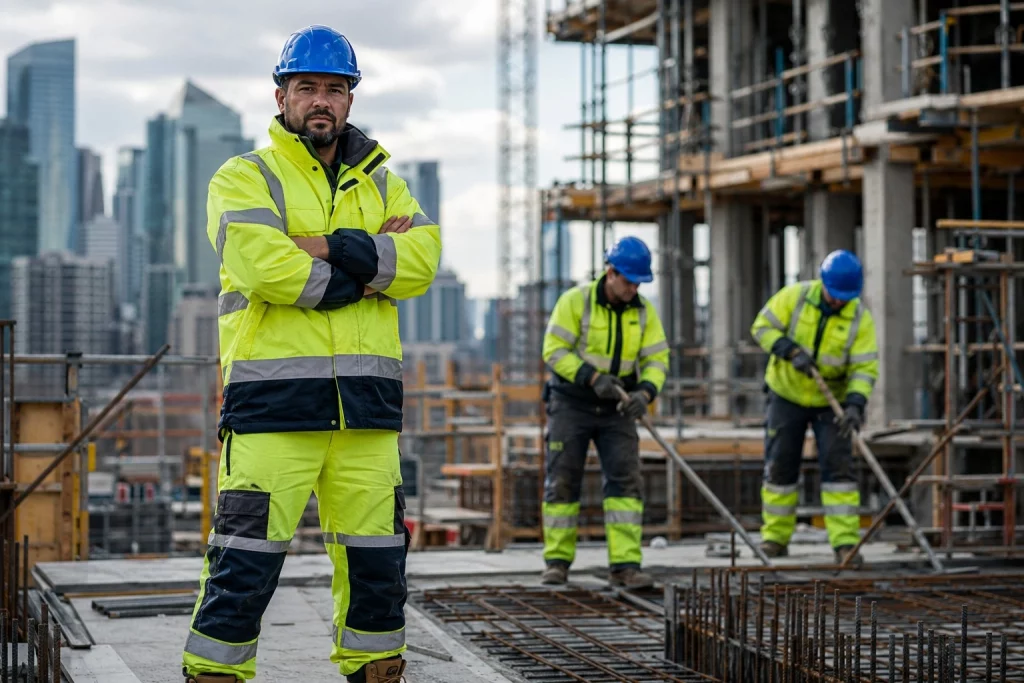
- Hi-vis shirts and vests rated for your site’s exposure level
- Weather-ready outerwear for cold mornings and wet afternoons
- FR layers where the hazard assessment calls for them
- Branded polos or button-ups for supervisors and client-facing roles
Carhartt workwear shows up on more Newark job sites than any other brand for a reason; it’s built for exactly this kind of abuse. But brand loyalty shouldn’t override fit and function. The best piece is the one your crew will actually wear correctly, every shift, without complaining.
Work Boots: The Part of the Uniform People Forget
Managers spend weeks picking shirt colors and forget boots entirely. That’s backwards. Work boots take more daily punishment than anything else on the list: impact, electrical hazards, wet concrete, slick surfaces.
ASTM F2413-rated safety-toe boots are standard on most sites, full stop. Beyond that, look at slip resistance for wet or oily floors, and electrical hazard protection if your crew works anywhere near live wiring. Skimping on boots to save a few dollars is the fastest way to end up with a workers’ comp claim.
But here’s a real observation from the field: boots wear out faster than every other piece of the uniform. Budget for replacement every six to twelve months, not once a year on autopilot.
Buy vs. Rent vs. Managed Program: What’s Actually Worth It
There’s no universal right answer here; it depends on crew size, how many sites you’re running, and how much admin time you’re willing to spend babysitting uniforms. Here’s how the three models actually compare.
Direct Purchase
Buying outright gives you full ownership and no recurring fees. It works well for smaller crews or companies that don’t mind handling replacement and upkeep themselves. The tradeoff is upfront cost and the admin work of tracking sizes, reorders, and wear-and-tear on your own.
Rental Programs
Rental shifts laundering and replacement onto the provider, which sounds great until you hit long-term contracts and per-garment fees that creep up. Uniform rental vs. purchase really comes down to whether you’d rather pay monthly and outsource the hassle, or pay once and own the headache.
Managed/Branded Uniform Programs
When it comes to construction crew workwear, a managed uniform program splits the difference. You get custom branded workwear, sizing support, and reorder tracking, but you still own the gear instead of renting it indefinitely. For companies running multiple crews or multiple sites, the ROI shows up fast: less time spent chasing sizes, fewer mismatched uniforms showing up to job walks, and a consistent look that actually represents your brand.
Here’s how the three models stack up side by side:
|
Feature |
Direct Purchase | Rental Program |
Managed Program |
|
Ownership |
You own the gear | Provider owns the gear |
You own the gear |
|
Upfront Cost |
Higher | Low to none |
Moderate |
|
Recurring Fees |
None | Monthly per-garment fees |
Reorder-based, not per-wear |
|
Laundering & Upkeep |
Your responsibility | Included |
Your responsibility |
|
Admin Workload |
High, you track sizes and reorders | Low, provider handles logistics |
Low, provider supports sizing and tracking |
|
Branding & Customization |
Optional, self-managed | Limited |
Built in |
|
Best For |
Small, stable crews | Crews wanting zero upkeep |
Multi-crew or multi-site operations |
Cost-wise, managed programs usually land between straight purchase and rental over a two-year window, once you factor in the admin time buying and rental both eat up.
Switching to a New Uniform Program Without Slowing Down Your Crew
Rolling out new gear sounds simple until you try doing it mid-project. Get the timing and logistics wrong, and you’ll lose more productivity than the old uniforms were costing you. Here’s how to do it without disrupting the job.
Timing the rollout so it doesn’t hit mid-project
Don’t launch new construction crew workwear in the middle of a deadline crunch. Roll it out between projects or at the start of a new contract, when a few days of sizing and distribution won’t cost you schedule time.
Sizing and fitting without pulling crews off-site
You don’t need to pull an entire crew off a job to get sizes right. A good provider can handle sizing through a quick on-site visit, a sizing kit, or a simple self-measurement guide sent out ahead of time. That’s one less excuse for delay.
Phasing old gear out instead of a hard cutover
A hard cutover, everyone in new gear on day one, sounds clean but rarely works. Old uniforms still have wear left in them. Phase them out as they degrade instead of tossing usable gear, and you’ll save money while the transition settles in naturally.
Choosing a Workwear Provider in Newark, NJ
Not every supplier is built the same, and picking the wrong one costs you more than money; it costs you turnaround time when you need gear fast. Here’s what separates a provider worth keeping from one you’ll be switching away from in a year.
Local turnaround vs. national catalog suppliers
A national catalog supplier ships from wherever, on their schedule. A local Newark, NJ uniform Workwear provider can turn around a rush order, handle an exchange in person, and actually know your jobsite conditions instead of guessing from a spec sheet. When a crew shows up short on hi-vis vests two days before an inspection, that difference is the whole ballgame.
In-house customization and branding capability
Ask whether embroidery, screen printing, and striping happen in-house or get outsourced. In-house workwear customization means faster turnaround and fewer surprises on quality. It also means your branding, logo placement, colors, sizing- gets handled by people who see the finished product before it ships, not a factory three states away.
What to look for in a provider:
- Local turnaround time for rush orders
- In-house embroidery, screen printing, and striping
- Sizing support that doesn’t require pulling crews off-site
- A track record with construction-specific compliance needs
If you’re weighing providers, WHDR’s construction workwear program covers direct purchase, managed uniform programs, and in-house customization out of their Newark location, worth a look before you commit to a national chain.
FAQs
What’s the best fabric for construction work uniforms?
Tear-resistant, moisture-wicking blends hold up best. Cotton duck and reinforced synthetics are the most common choices for durability, with moisture-wicking layers underneath for hot Newark summers.
Do construction crews need FR-rated clothing?
Only if a hazard assessment identifies arc flash or fire exposure. Electricians and welders usually need it. General laborers typically don’t, unless site conditions say otherwise.
Is it cheaper to rent or buy construction uniforms?
It depends on crew size and how often you replace gear. Buying wins for smaller, stable crews. Rental or managed programs often win for larger operations juggling multiple sites.
What hi-vis requirements apply to NJ job sites?
Most sites follow ANSI/ISEA 107 standards, with Class 2 hi-vis required on federal-aid highway projects. Your specific requirement depends on traffic exposure and lighting conditions on site.
Can construction uniforms be branded with a company logo?
Yes. Embroidery, screen printing, and heat-transfer branding are all standard options. In-house customization typically means faster turnaround than outsourced branding.