
Branded Workwear Shirts in Newark, NJ: Premium & Affordable Options
Sep
A logo on a cheap shirt still looks like a cheap shirt. Branded workwear shirts in Newark, NJ, need to do two jobs at once, hold up to a real workday, and represent a company well while doing it. Most shirts fail at one or the other. The good ones don’t.
This isn’t a product listing. It’s a real look at what actually separates a good branded workwear shirt from a bad one, and how to pick between polos, T-shirts, and everything in between without guessing.
Workwear Shirts vs. Regular Shirts: What’s the Difference?
A regular T-shirt from a department store wasn’t built for eight hours of physical work, repeated industrial washing, or looking sharp in front of a customer at hour six.
Branded workwear shirts have to handle:
- Repeated washing without fading or breaking down
- Moisture-wicking performance for hot shifts
- Snag resistance for anyone working around tools or equipment
- A fit that moves with the body instead of fighting it
Workwear clothing exists as its own category for a reason. Grab a shirt off a regular rack, and you’re gambling on all four of these at once.
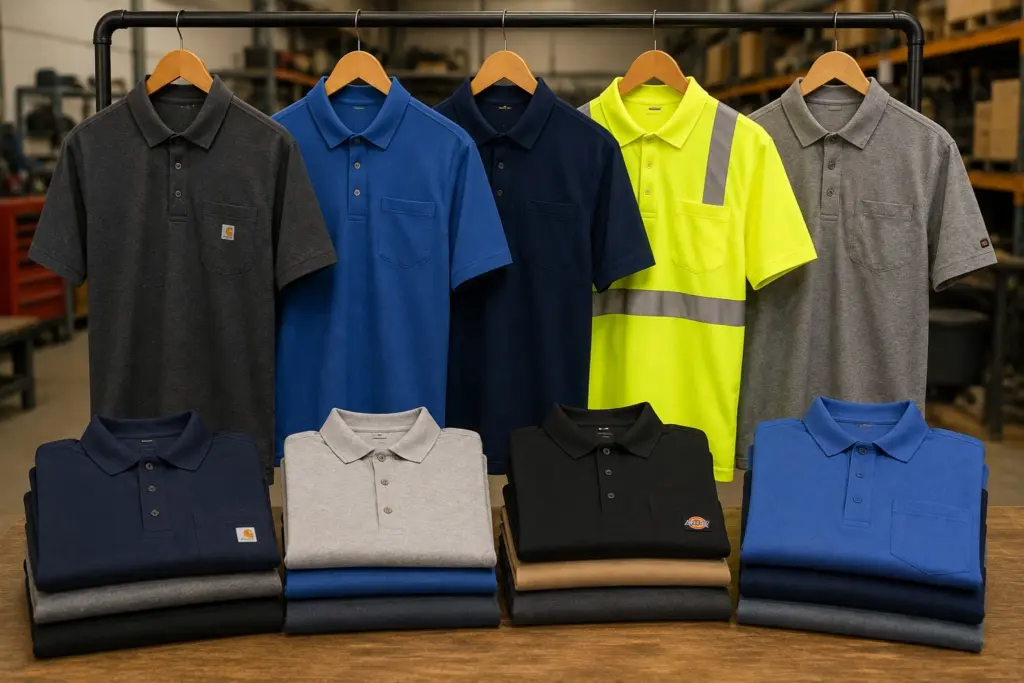
Polo Shirts: The Core of Any Workwear Program
Polos are where most workwear programs start, and for good reason. They land right between “too casual” and “too formal” for almost every job that needs a uniform.
Men’s Polo Shirts: Fit and Fabric Options
Men’s polo shirts for workwear in Newark typically run in a performance knit, moisture-wicking, snag-resistant, built for movement. A team fit through the shoulders and chest holds up better under daily wear than a slim cut that restricts reach.
Women’s Polo Shirts: Real Fit, Not Scaled-Down Men’s Styles
A women’s polo built right accounts for a different shape through the waist and shoulders. Two-tone and color-block options exist specifically because women’s workwear shouldn’t be an afterthought sized down from the men’s line.
Moisture-Wicking, Snag-Resistant & Dirt-Release Fabrics Explained
The best workwear polos use fabric engineered to release dirt and grease during washing, not just resist it temporarily. Snag-resistant knit holds up against daily wear-and-tear, and moisture-wicking properties keep a shirt wearable through a full sweaty shift instead of being soaked by lunch.
Hi-Vis & FR Polo Options for Higher-Risk Roles
Not every job needs a plain polo. Hi-vis polo options meet visibility standards for roles near traffic or moving equipment. FR station-wear polos exist for roles needing flame resistance without sacrificing the comfort a knit shirt offers over heavier woven fabric.
Work T-Shirts – When a Polo Isn’t the Right Call
T-shirts for work make sense when a job doesn’t need a collar, heavier labor, hotter conditions, or roles where a polo’s extra fabric just gets in the way. A good work t-shirt still needs the same durability and moisture-wicking properties as a polo, just without the collar and buttons.
Women’s Work Shirts, Options Beyond Polos
Ladies’ shirts for work cover more than one style. Beyond polos, women’s workwear options include button-front work shirts and long-sleeve station wear for roles needing more coverage. The same rule applies here as with polos: a real women’s cut, not a smaller men’s pattern.
Choosing the Right Workwear Shirt for Your Industry
Different jobs pull toward different shirt types, and the reasons aren’t random; they come down to what the shift actually demands.
- Construction and trades: durable t-shirts and heavier work shirts that survive abrasion, dust, and daily wear on-site
- Automotive shops: polos for front-counter and service advisor roles, t-shirts or FR options for technicians working near heat, engine fluids, and grease
- Healthcare settings: polos and button-front shirts that stay professional through a full shift and hold up to frequent washing
- Retail and customer-facing roles: polos almost across the board, balancing comfort with a presentable look at the register or floor
- Service and office teams: polo-first, prioritizing a clean, consistent look over heavy-duty features they don’t actually need
- Higher-risk environments: hi-vis or FR shirts specifically, chosen based on the actual hazard a role faces, not what looks safety-appropriate on a shelf
The pattern across all of these: the shirt follows the job, not the other way around. A business picking one style for the whole team usually ends up with some employees over-equipped and others under-protected.
Brands That Actually Matter: Carhartt, Dickies, Edwards & Red Kap
Not every brand solves the same problem. Carhartt covers the heavy-duty end, built for abuse, not just daily wear. Dickies brings reliable, no-frills basics across shirts and T-shirts. Edwards specializes in professional and hospitality-grade shirts, the better choice for client-facing roles. Red Kap rounds out the lineup with dependable industrial workwear across the board.
Why Choose Work Hard Dress Right for Workwear Shirts in Newark, NJ
For businesses looking for branded workwear shirts in Newark, NJ, there’s no need to piece together shirts from three different vendors to outfit a mixed team. Work Hard Dress Right carries the full range in one place:
- Local availability out of the Newark location, not just an online catalog
- Work shirts, t-shirts, and polos covering every role from technicians to front-counter staff
- Real men’s and women’s options, not a unisex fit stretched across everyone
- Carhartt, Dickies, Edwards, and Red Kap all carried in-house
- In-house custom embroidery and branding, so a logo doesn’t add weeks to an order
- Options built for different industries and risk levels, from a standard polo to hi-vis and FR shirts
That range matters more once a business is outfitting more than one type of role at once.
Premium vs. Affordable: What You’re Actually Paying For
Price differences in workwear branded workwear shirts usually come down to a few real factors: fabric weight and technology, brand reputation, safety features like hi-vis or FR ratings, customization method, and how well a shirt survives industrial laundering.
Affordable options work fine for lower-wear roles or occasional use. Premium shirts make more sense for daily wear, client-facing roles, or anyone whose shirt needs to survive years of regular washing without looking tired.
Workwear Shirt Types Compared
|
Shirt Type |
Best For | Key Features |
Consideration |
|
Polo Shirt |
Customer-facing, most general roles | Moisture-wicking, snag-resistant, professional look |
Less coverage than a full work shirt |
|
Work T-Shirt |
Heavy labor, hot conditions | Durable, breathable, no collar |
Less polished for client-facing roles |
|
Button-Front Work Shirt |
Healthcare, professional settings | More coverage, structured look |
Less breathable than a T-shirt |
|
Hi-Vis Shirt |
Roadside, equipment-adjacent work | Designed to meet applicable high-visibility standards |
Not needed for low-risk roles |
|
FR Shirt |
Jobs with specific flame/flash-fire hazards | Flame-resistant protection for applicable hazards |
Must match the required hazard rating |
Custom Branding on Workwear Shirts
A shirt with a logo does more than look official; it’s free advertising every time an employee steps outside the building. Custom branding on workwear shirts gives businesses a way to keep that exposure consistent across every employee and shift.
Embroidery is a durable branding option for polos and work shirts, and it can hold up well through repeated washing when properly applied and cared for. In-house embroidery means a company doesn’t wait weeks between placing an order and seeing it on the floor, a real difference when a new hire starts Monday and needs a branded shirt by then, not sometime next month.
Common Mistakes When Buying Workwear Shirts
Most of these mistakes don’t show up until the second order; by then, the wrong choice has already cost time and money once.
- Choosing one shirt style for every role instead of matching gear to what the job actually needs
- Buying men’s sizing for women’s roles instead of stocking a real women’s fit
- Skipping hi-vis or FR requirements because a shirt “looks safety-appropriate”
- Picking the cheapest option and reordering within a season
- Ignoring fabric technology and assuming all cotton or all polyester performs the same
None of these are hard to catch. They just need to be checked before the order goes out, not after it’s already on the floor.
Conclusion
Branded workwear shirts in Newark, NJ, come down to matching the shirt to the actual job, the right fit, the right fabric, and branding that holds up as long as the shirt does. Get that match right once, and reorders stop being a guessing game every season.
Contact Work Hard Dress Right to outfit your team with shirts built for the work, not just the photo.
FAQs
- What are the best branded workwear shirts for work?
It depends on the role. Polos work well for most customer-facing and general roles, while T-shirts suit heavier labor and hi-vis or FR shirts cover specific hazard-driven roles.
- Are polo shirts suitable for work uniforms?
Yes. Polos are the most common choice for workwear programs because they balance a professional look with the durability and moisture-wicking performance a real shift requires.
- What are the best workwear shirts for men?
Performance-knit polos and durable work T-shirts in a team fit tend to hold up best, especially with moisture-wicking and snag-resistant fabric.
- Can workwear shirts be embroidered with a company logo?
Yes. Embroidery is the most durable branding option for both polos and work shirts, holding up through repeated industrial washing better than a printed logo.
- Are there women’s branded workwear shirt options?
Yes. Real women’s-cut polos and work shirts exist specifically to fit differently than a men’s style sized down, and they’re worth seeking out over a unisex fit.
- What’s the difference between FR and regular work shirts?
FR shirts use flame-resistant rated fabric for roles with fire or arc flash exposure. Regular work shirts offer no such protection and shouldn’t be substituted in hazard-driven roles.
"