
Custom Healthcare Scrubs & Uniforms in Newark, NJ
Jul
Custom healthcare scrubs Newark facilities orders aren’t just about a logo on a shirt. They’re about staff who look like a team, not five different vendors. If you’re outfitting nurses, techs, or front-desk staff, getting the branding right matters. It shows more than people expect.
This matters whether you run a single clinic or a multi-department hospital system. A well-run scrub customization program saves time on every reorder. It also builds the kind of visual trust patients notice the second they walk in.
Why Newark and New Haven Healthcare Facilities Customize Scrubs
Team unity is the obvious reason. But it’s not the only one. Custom healthcare scrubs Newark hospitals use also solve a real logistics problem: who’s who, and fast.
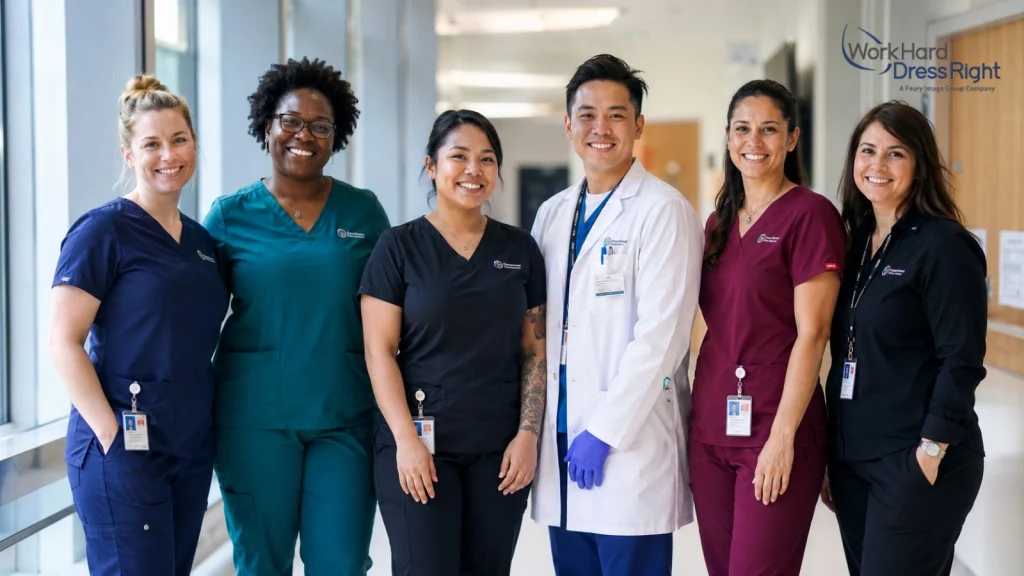
A patient in a busy ER doesn’t have time to guess roles. Color-coded, logo-branded scrubs answer that question instantly. Navy for nursing. Teal for lab techs. Black for administration. New hires learn the system in a day, not a month.
Corporate uniform solutions built around this kind of visual system do more than look sharp. They cut down on confusion at the front desk. They also make a facility feel organized before a single word is spoken.
There’s a staffing angle too, one that’s easy to overlook. Facilities that rotate staff or bring in agency nurses need a system that keeps pace. A branded, color-coded scrub setup means a temporary hire looks and reads correctly on day one. No manager has to explain the color chart every time someone new starts a shift.
Patients and families notice more than most facilities realize. A consistent, branded look reads as organized and professional before anyone says a word. Custom scrub branding isn’t just internal housekeeping. It’s part of how a facility is perceived the moment someone walks through the door.
Embroidery vs. Screen Printing vs. Heat-Seal for Scrubs
Not every decoration method holds up the same way. Hospital-grade laundering is brutal on fabric. It’s worth knowing the difference before you order five hundred shirts.
- Embroidery is the most durable option for scrubs. Thread survives repeated industrial washing far better than most printed applications. It costs more per item, but it lasts through years of shifts, not months.
- Screen printing works well for larger, bolder designs and lower per-item costs on big orders. It’s a strong fit for department names or campaign-style branding. It can crack or fade faster than embroidery under heavy commercial laundering, though.
- Heat-seal applications sit in between. They’re fast to apply. They work well for smaller logos on technical or stretch fabrics, where stitching isn’t practical. They also need a gentler wash cycle to hold up over the long term. That makes them a weaker fit for scrubs washed daily at high heat.
None of these methods is universally “best.” The right one depends on the garment, the wash frequency, and the budget. A good supplier walks you through that trade-off instead of pushing whichever method is easiest for them.
A lot of facilities mix methods within one order. Embroidery for the main logo on the chest. Screen printing for a bigger department name across the back. That combination often gives the best balance of durability and cost, especially on larger bulk orders where every dollar per unit adds up fast.
In-House Production vs. Fragmented Supply Chains
Here’s where most facilities run into trouble without realizing it. Many local decoration shops only handle the embroidery or printing itself. They don’t supply the actual garment.
- Call these siloed contract decorators. You order scrubs from one company. You ship them to a second company for logos. Then you wait for both to sync up before anything reaches your team. One shipping delay on either end pushes your whole timeline back, and nobody’s fully accountable for the final result.
- Then there’s the opposite problem: distant retail boutiques. These shops are set up for walk-in individual shoppers, not B2B ordering. They don’t run centralized online portals. They don’t manage allotments or department budgets. And if they’re a thirty-minute drive from your facility, same-day fittings or urgent reorders simply aren’t realistic.
A facility ordering custom healthcare scrubs, Newark-based, with production and inventory under one roof, skips both problems. One vendor supplies the garment and applies the branding in the same building. Nothing gets lost between two separate companies, and nothing waits on a shop that’s built for retail traffic instead of healthcare accounts.
Lab Coats, Warm-Ups, and Beyond Scrub Tops
Scrub tops get most of the attention, but they’re rarely the only garment a facility needs branded. Lab coats carry the same logo and color-coding logic, and they matter just as much for identifying roles at a glance.
Warm-up jackets, administrative polos, and even front-desk uniforms benefit from the same treatment. A facility that only brands its scrub tops ends up with a mismatched look the moment someone puts on a jacket over it. Covering the full wardrobe, not just one garment type, is what actually makes a uniform program look intentional instead of half-finished.
Color-Coding by Department: How It Actually Works
A color system only works if it’s consistent and simple enough that nobody has to think about it. Most facilities land on three to five colors, tied directly to department function.
|
Color |
Department |
|---|---|
|
Navy or ceiling blue |
Nursing staff — the largest group on most floors |
|
Teal or hunter green |
Lab technicians and phlebotomy |
|
Black or charcoal |
Administrative and front-desk staff |
| Burgundy or maroon |
Physical therapy and rehab teams |
The exact colors matter less than the consistency. Once a system is set, every new hire gets outfitted the same way, every time. That consistency is what makes healthcare uniforms for nurses in Newark, NJ actually function as a system, not just a style choice.
Write the system down before your first order ships. A simple one-page chart, with color paired with department, saves confusion later. It also makes reordering fast. Nobody has to guess which shade of blue nursing uses, six months after the first order.
Facilities that skip this step often end up with mismatched colors across reorders. A jacket from one batch doesn’t quite match the scrub top from another. That’s a fixable problem, but only if the color codes are documented from day one instead of remembered informally by whoever placed the first order.
Pricing: Per-Item Customization vs. a Managed Program
Ordering customization one shirt at a time works for a five-person practice. It gets expensive and slow once you’re outfitting dozens of staff across shifts.
Per-item pricing makes sense for small, occasional orders. You pay a setup fee for the logo digitization once, then a per-piece charge on top of the garment cost each time you order.
A managed uniform program changes that math. Setup happens once. Pricing gets locked in across the whole catalogue. Staff reorders through an approved system instead of routing every request through a manager. For any facility outfitting more than a handful of people, the managed route almost always costs less per year, not more.
Proven With Real Healthcare Clients
Case studies matter more than promises. Work Hard Dress Right has real, named healthcare clients behind this kind of customization work.
Cornell Scott-Hill Health Center needed coordinated scrubs, security apparel, and administrative uniforms across a growing organization. Custom branding through embroidery, screen printing, and heat-seal applications tied every department together under one consistent look.
Yale New Haven Health faced a different challenge: outfitting staff across every shift without a bottleneck. A custom ordering system gave every department consistent, branded scrubs without slowing down hiring or reorders.
Both are large, real accounts, not hypothetical examples. A supplier that can run programs at that scale, while still filling a small clinic’s order the same week, is doing something most local shops can’t manage. It’s also the clearest proof that custom healthcare scrubs Newark facilities order here hold up at real scale, not just in a small sample batch.
Setting Up Customization for Your Facility
Getting started doesn’t require a huge commitment on day one. Most facilities follow a simple path.
- Pick your garments. Scrub tops, lab coats, warm-ups: decide what gets branded first.
- Choose your colors and system. Lock in department color-coding before the first order ships.
- Digitize your logo. This happens once and gets reused on every future order.
- Place a trial order. Start with one department before rolling out facility-wide.
- Scale into a managed program. Once volume justifies it, move to locked pricing and a reorder catalogue.
Facilities that follow this order avoid the most common mistake: ordering in bulk before the color system and logo digitization are actually finalized.
Skipping the trial order is the second most common mistake. A logo that looks right on screen doesn’t always sit right on fabric. Stitching direction, thread color under fluorescent lighting, and placement on a curved seam all look different in person than in a design file. A single test order catches these problems before they show up on two hundred shirts.
For facilities specifically searching for custom healthcare scrubs, Newark suppliers can walk them through the process in person. That in-person trial step is one of the biggest reasons to work with a local production shop instead of a mail-order vendor. A design correction takes a same-day conversation, not a week of back-and-forth email.
Getting Started With Work Hard Dress Right
Custom healthcare scrubs that Newark and New Haven facilities need don’t have to come from three different vendors. Work Hard Dress Right handles the garment, the decoration, and the ongoing program from one local production facility.
Contact Work Hard Dress Right to talk through your team’s sizing, branding, and program setup, or visit 283 Ferry Street in Newark, NJ or 2 Howe Street in New Haven, CT, to see samples in person.
FAQs
What’s the most durable decoration method for scrubs?
Embroidery holds up best under repeated hospital-grade laundering. Screen printing and heat-seal are good options too, but they wear faster over time.
Can I add customization to scrubs staff already own?
Usually, yes, if the fabric and fit are compatible. It’s best to check with your supplier before committing to a full order.
Is there a minimum order size for custom healthcare scrubs?
Smaller orders are usually fine for a single department. Larger, facility-wide orders typically get better per-item pricing.
How long does custom scrub branding take?
In-house production is faster than sending garments to a separate embroidery shop. Turnaround depends on order size and design complexity.
Does customization affect the fabric warranty?
Reputable suppliers use decoration methods that don’t void garment warranties. Always confirm this before a large order.
What’s the difference between per-item pricing and a managed program?
Per-item pricing suits small, occasional orders. A managed program locks in pricing and simplifies reordering for larger teams.
Do lab coats need the same color-coding as scrubs?
Yes. Consistent branding across every garment type is what makes a uniform system actually work.